Chapter 2
Reading the emagram yourself
Take a sounding and, on your own, in five minutes, draw from it how the day will unfold.
The essentials in two minutes
- An emagram is two curves of the day (T as a solid line, Td dashed) laid over fixed rails: the dry adiabat (−1 °C / 100 m), the saturated adiabat (≈ −0.55) and the mixing-ratio line (≈ −0.2).
- Three readings with the naked eye first: the T − Td spread (moist or dry), the slope of T (unstable or stable), the inversions (T leaning to the right as it rises).
- Step 1: the top of the nocturnal inversion brought back down to the ground along the dry rail gives the trigger temperature, and so the time of the first thermals; the margin Tmax − Ttrig says whether the day will be sluggish (under 2 °C), classic (3 to 5) or early (over 6).
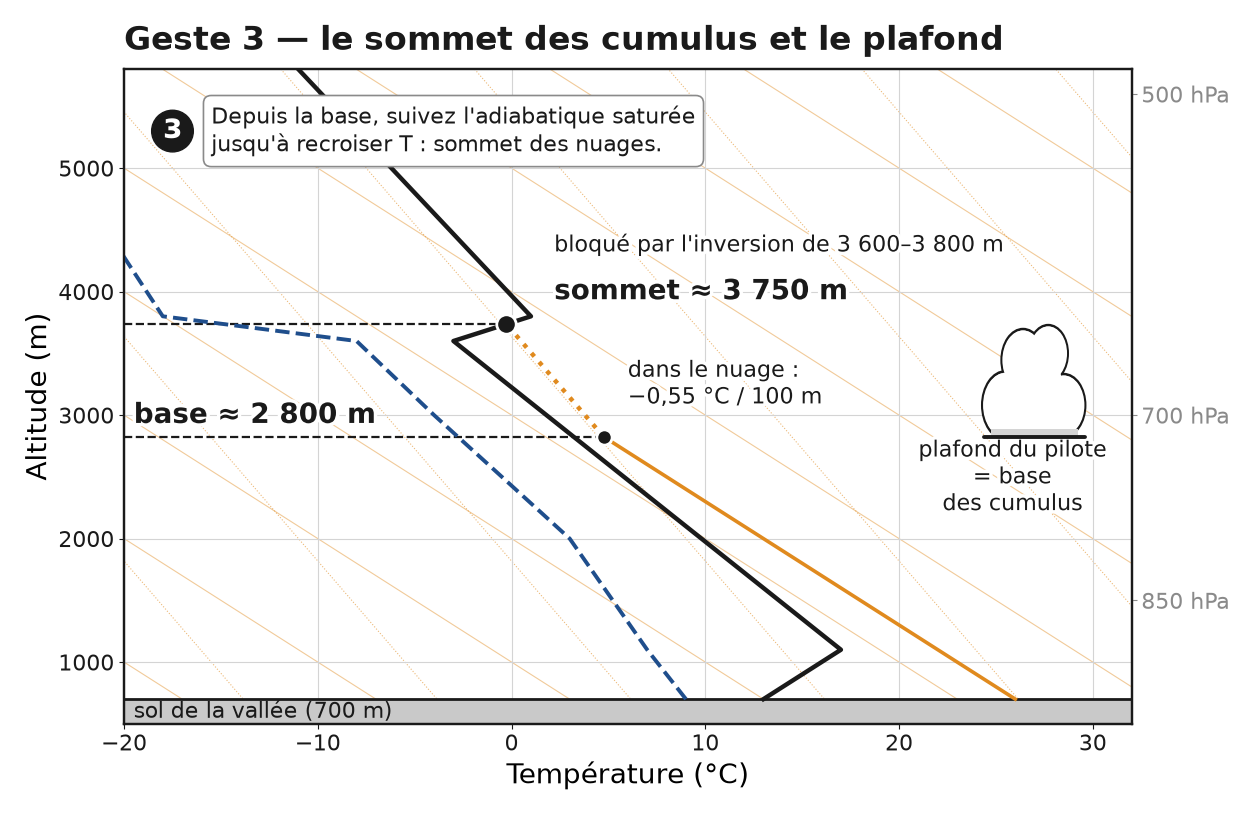
- Steps 2 and 3: Tmax taken up the dry rail and Td taken up the mixing-ratio line cross at the base; the saturated rail leads to the cloud tops, where it crosses the environment curve again.
- Step 4: the depth of the cumulus says whether it can rain (under 1,000 m: well-behaved; over 2,000 m: showers); the bubble − environment gap halfway up the layer gives the strength (1 °C gentle, 2 to 3 good, over 4 strong).
- CIN = toll, CAPE = fuel: a strong CAPE (over 1,000 J/kg) under a CIN that holds in the morning means an afternoon thunderstorm.
- A valley sounding underestimates the base over a large massif, often by 300 to 800 m; and a sounding is always cross-checked against the morning sky.
- Four summer faces: blue day, well-behaved cumulus, overdevelopment, low inversion — plus the grey murk.