Chapter 3
General circulation: why the air goes round
Pressure, the Earth’s rotation, friction: three bricks, and everything else follows from them.
The essentials in two minutes
- The only engine of the wind is the difference in pressure; an isobaric chart reads like a relief map: tight isobars, strong wind.
- Coriolis, an apparent force due to the Earth’s rotation, deflects all motion to the right in the northern hemisphere; it matters for the wind on the charts, not for a thermal or a breeze.
- In balance, the wind follows the isobars with low pressure on its left: lows turn anticlockwise, anticyclones clockwise.
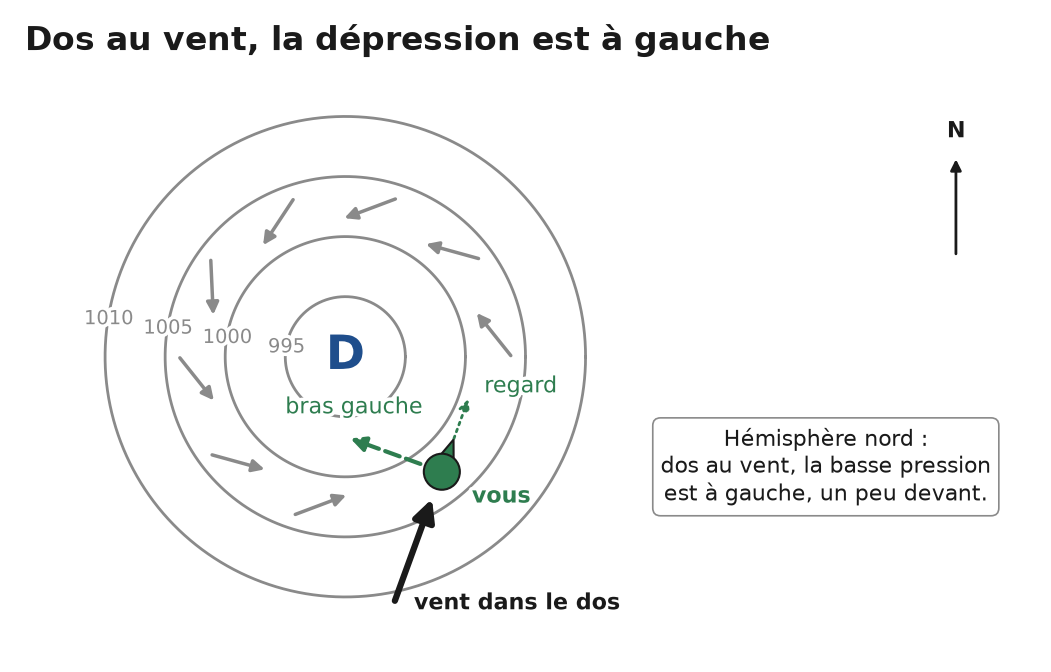
- Buys Ballot’s law: with your back to the wind, the low is on your left, a little ahead.
- Near the ground, friction makes the wind cut across the isobars towards low pressure: convergence and rising air under lows (cloud, rain), divergence and subsidence under anticyclones (clear sky, inversion).
- Going up, the wind veers and strengthens: the wind at launch is not the wind on the chart; above the ridges, you find the chart’s wind again.
- Under an old anticyclone, the subsidence inversion sinks day after day and the ceilings melt away: the great days are on the edge of an anticyclone or in dried-out post-frontal air.
- Three cells per hemisphere; in our latitudes, a zone of conflict where the jet stream (9 to 12 km, 150 to 350 km/h) meanders: lows are born ahead of its troughs.