Chapter 1
Physics of the atmosphere
Is a bubble of air that you lift warmer or colder than the air around it? The answer decides everything.
The essentials in two minutes
- The atmosphere is heated from below: convection always starts from the ground, and the temperature falls on average by 0.65 °C per 100 m.
- A rising bubble expands and cools by 1 °C per 100 m as long as it is dry, and by about 0.55 °C per 100 m inside the cloud: this is physics, not weather.
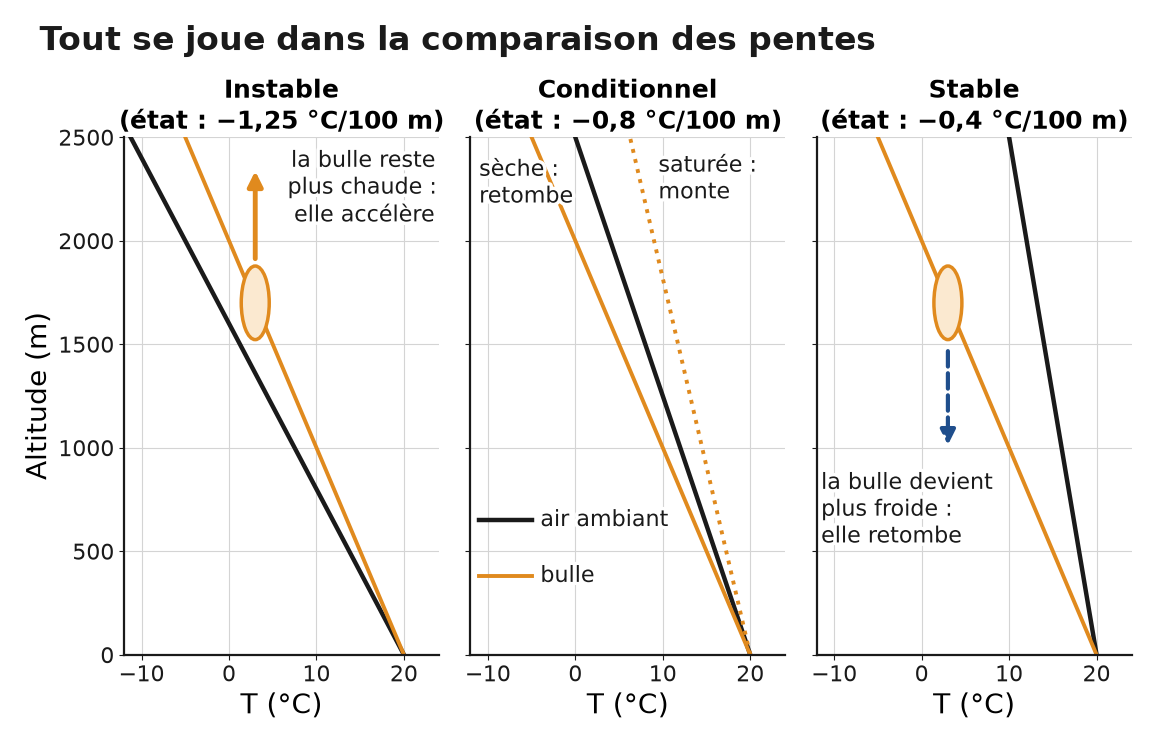
- The day’s weather is the environment curve: if the surrounding air cools faster than the bubble, the bubble rises (unstable); if it cools more slowly, the bubble sinks back (stable).
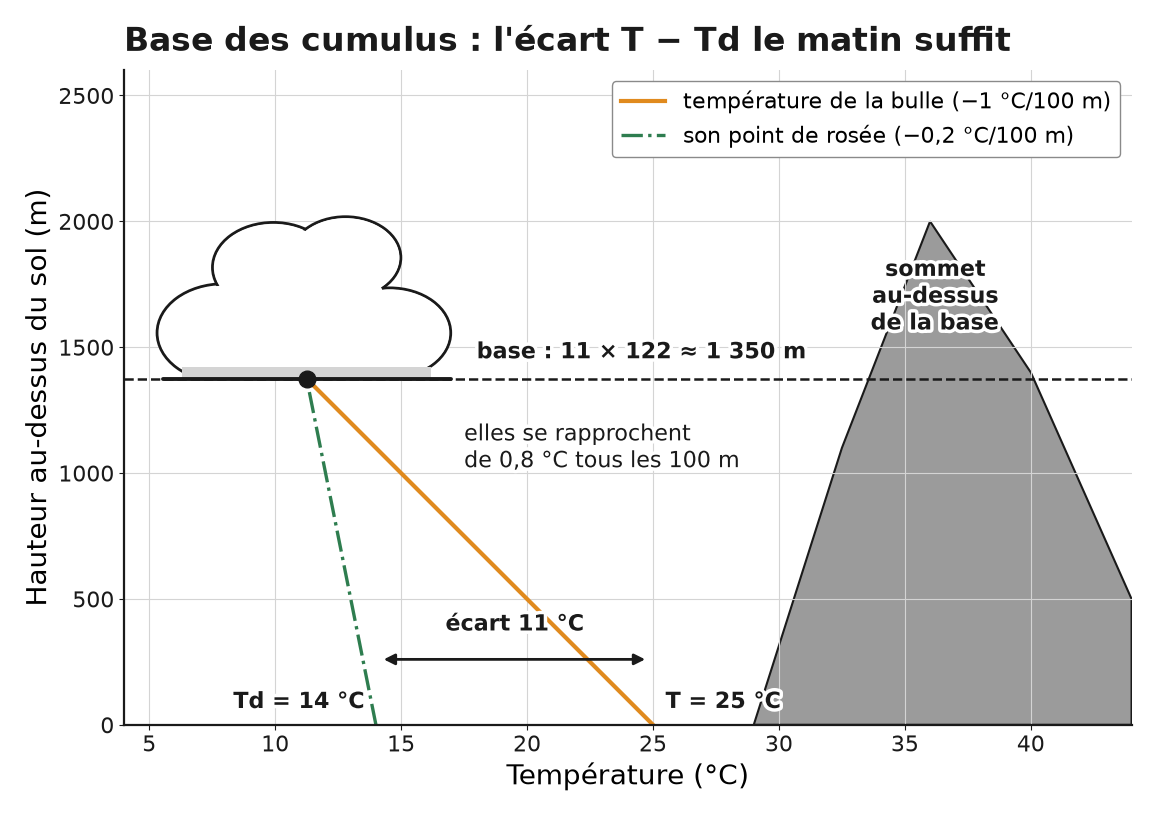
- Think in dew point, not relative humidity: the T − Td spread gives the cumulus base, about 122 m per degree, to be added to the altitude of the weather station.
- An inversion is a lid: a radiation inversion at night near the ground, a subsidence inversion under anticyclones, a frontal inversion ahead of warm fronts.
- Three ways a thermal stops: a soft ceiling (the spread melts away), a concrete ceiling (an inversion), and a reprieve inside the cloud thanks to latent heat (about 2,500 J per gram).
- Convective rain needs depth: under 2,000 m, nothing; over 3,000 m with an icy top, showers; a cumulonimbus, a thunderstorm.
- Your altimeter is a barometer: at the mountain hut, if it “climbs” 40 to 60 m during the night, the pressure has fallen by 4 to 6 hPa and a deterioration is on its way.
Quiz: 12 questions