Chapter 7
Breezes: how the valleys breathe
When the general wind falls silent, the mountain makes its own wind, always in the same order and at almost the same time.
The essentials in two minutes
- Air heated by the slope: upslope breeze (1 to 3 m/s, a thin layer); cooled air: downslope breeze and a cold-air pool on the valley floor. Breezes rule when the general wind is light (under 10 km/h at the summits).
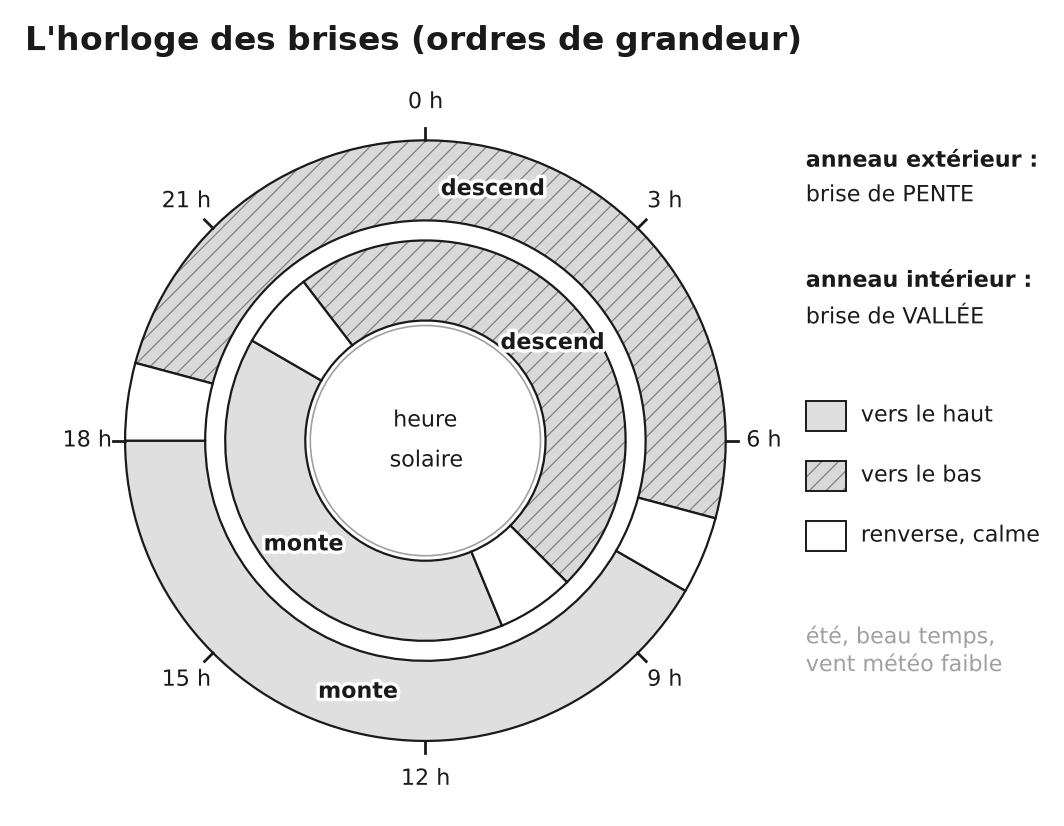
- The whole valley breathes: an up-valley breeze in the afternoon (10 to 20 km/h, 25 to 35 in the large valleys), a down-valley mountain breeze at night (5 to 15 km/h).
- The slopes switch over quickly, the valley follows two to three hours later; think in solar time (summer: clock time − 1 h 30 min).
- Each side has its hour: east in the morning, south at midday, west in the afternoon.
- Convergences (ridges, confluences, passes, breeze fronts) give the best lift and the first cumulus — and the first showers on unstable days.
- Over a lake in the afternoon: stable air, no thermals; a breeze from the water towards the shore.
- On landing: final approach into the valley breeze, away from the wake of obstacles, and watch out for the evening reversal.
- General wind over the back at launch: the breeze can make it look like a good launch; it is the general wind that decides. For the hiker, the midday wind and the afternoon cumulus are normal; it is how fast they grow that is the warning.