Chapter 6
Wind and terrain
The wind on the charts is a river; the mountains turn it into a torrent.
The essentials in two minutes
- The wind weakens near the ground (wind gradient, a boundary layer 500 to 1,500 m deep); afternoon thermals bring the upper wind down to the ground, in gusts.
- Facing the wind, the air rises (ridge lift ≈ wind × sine of the slope); above the ridge, it speeds up (compression, × 1.5 to 2); in a pass too (venturi).
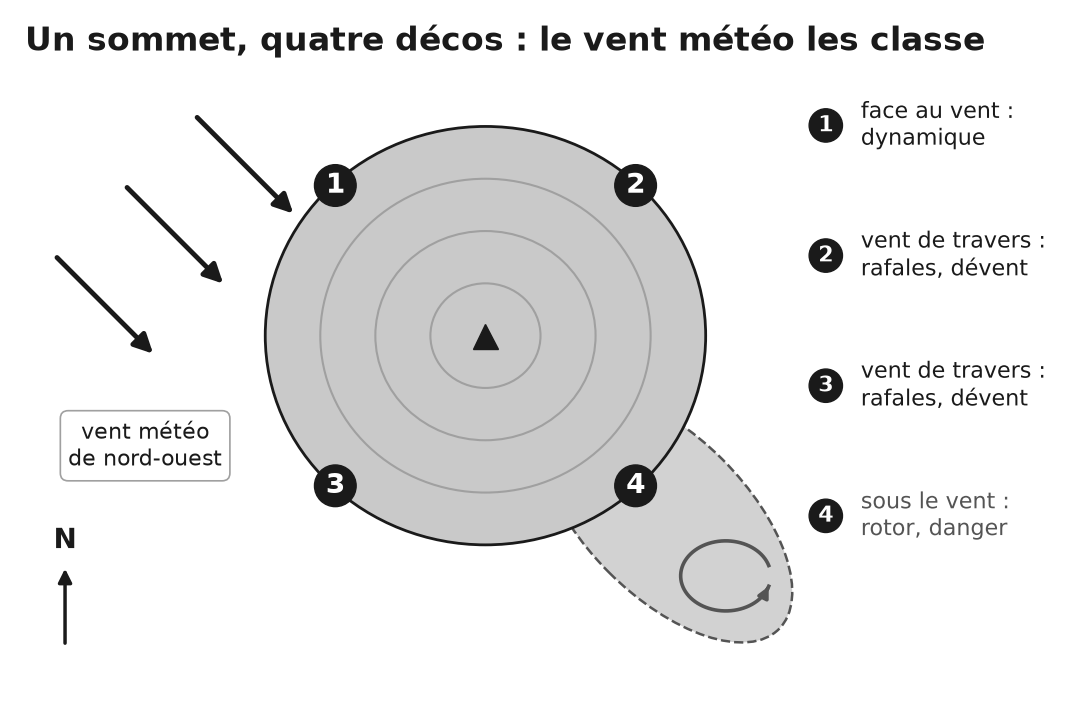
- In the lee, the air plunges, breaks away and spins into rotors: you don’t launch there and you don’t fly there, whatever the wind in the windsock; the turbulence extends over 5 to 10 times the height of the obstacle.
- The general wind at summit level decides the launch: into wind, crosswind (gusts) or in the lee (rotor); a launch that contradicts the general wind is lying.
- Wind shear separates two winds: the top of the breeze, the top of the inversion, the edge of the rotor; choppy air.
- Foehn: rain on the windward side, heat, dryness and gusts in the lee, a foehn wall on the ridge; no flying, and keep an eye on the ridges.
- Lenticulars: strong wind aloft (at least 25 to 35 km/h at the ridges), stable air, possible rotors; a warning signal for pilots and hikers.
- Wind multiplies the cold: at 0 °C and 50 km/h, it feels like −8 °C; a windproof and a hat in every season, and the jacket on before the pass.